
Selected for the CNTAC–ANTA Joint Research Program | ARCHIBIO Delivers a “Bio-Answer” on Recycled Polyester

跳转到章节
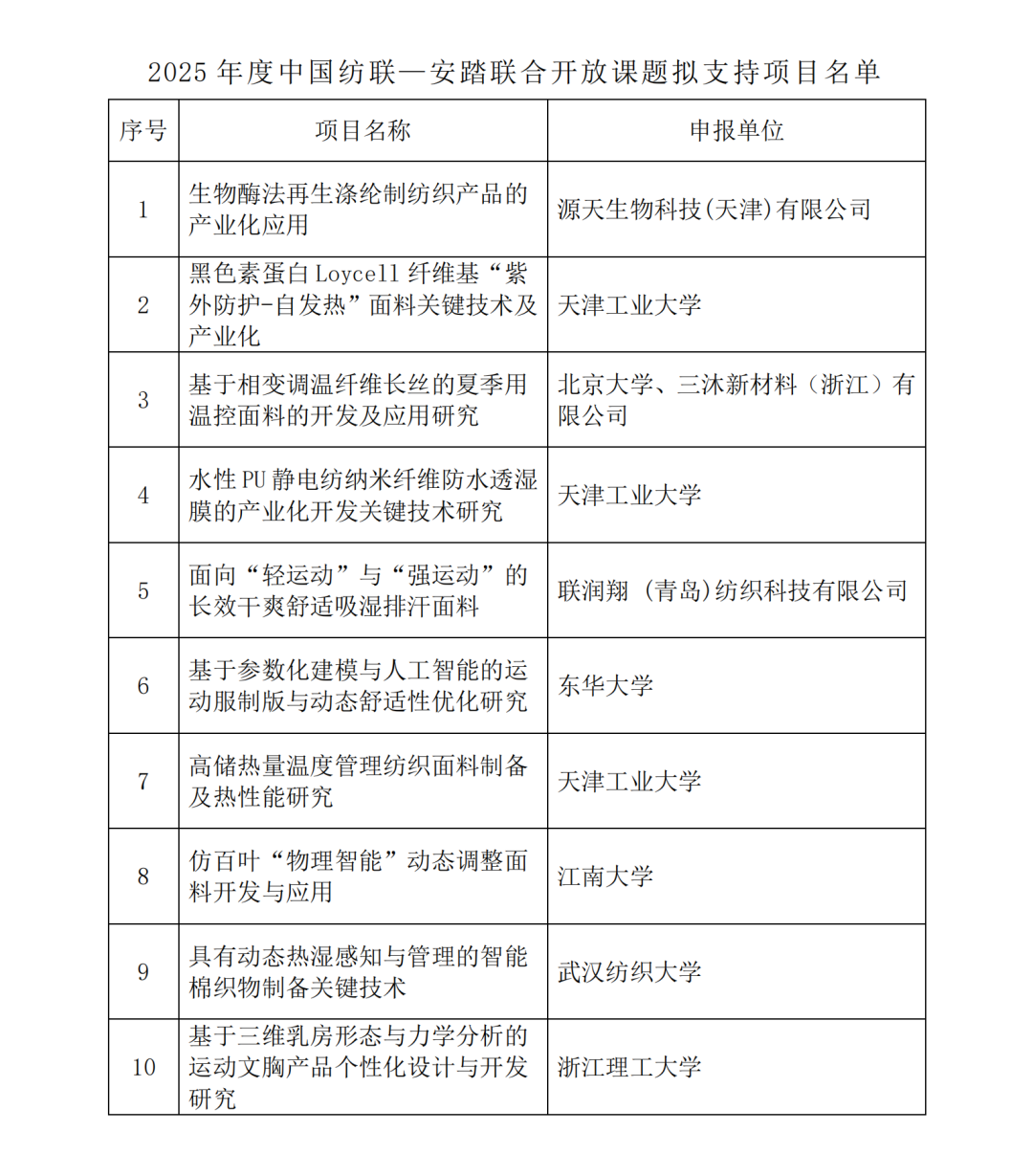
Recently, the China National Textile and Apparel Council (CNTAC) released the list of proposed projects to be supported under the “2025 CNTAC–ANTA Joint Open Research Program.”ARCHIBIO was successfully selected for its project, “Industrial Application of Bio-enzymatic Recycled Polyester in Textile Products.”
01
A “Weather Vane” for an Industry
The joint open research program established by CNTAC and ANTA Group is itself an industry signal worth noting.
As an authoritative industry body, what CNTAC promotes has never been merely a breakthrough in a single technology, but the direction of the entire industry. ANTA, as a leading brand in China’s sporting goods industry, has R&D investment and innovation vision that directly reflect the downstream market’s real demand for material technologies.
Their collaboration answers one question: What kind of technological innovation deserves to be incorporated into the core system of the industry?
This open research program, centered on the core principles of “demand-oriented, innovation-driven, collaborative empowerment, and industrial implementation,” focuses on key technology R&D for functional materials for footwear and apparel. Among the five key support directions, “Integration and Demonstration Application of Low-Carbon Textile Technologies across the Full Lifecycle of Footwear and Apparel” is prominently included.
This is precisely where the value of ARCHIBIO’s bio-enzymatic recycling technology lies—a technology choice that can achieve a “fiber-to-fiber” closed loop while being economically affordable and environmentally sustainable.
02
The Reconstructive Power of an “Enzyme Molecular Scissors”
What ARCHIBIO’s bio-enzymatic recycling offers is a switch in raw material sources without changing the existing polyester production and textile processing systems.
Its technological foundation is an “Ultra-Enzyme Factory” built with AI technology. Here, enzyme molecules are recombined and optimized, and YTZYME® with a “golden ratio” is screened and assembled. This “enzyme molecular scissors,” forged by artificial intelligence, precisely “cuts” waste polyester textiles down to basic monomers—terephthalic acid (rPTA) and ethylene glycol (rEG)—which can be polymerized into RB® PET and directly fed into existing polyester production lines.
For downstream fabric mills and garment factories, the process requires no changes, but the carbon footprint and sustainability attributes of the products have already undergone fundamental changes.
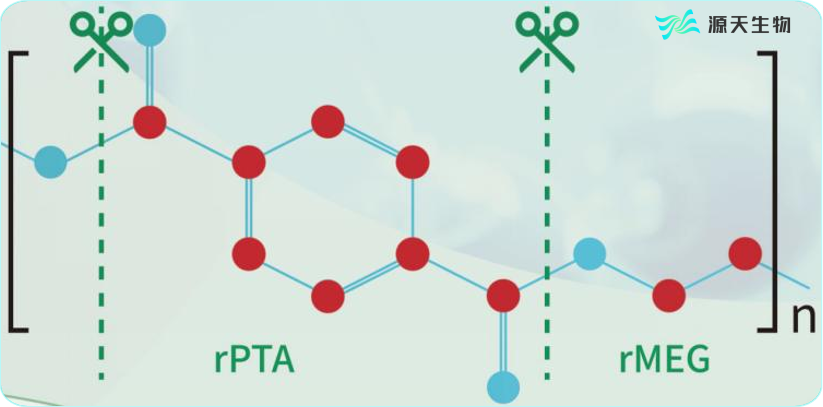
The core capabilities of this technology are reflected in three dimensions:
Smarter and more efficient
An “Ultra-Enzyme Factory” built with AI technology increases enzyme activity by 2,000 times, achieving a leap from “300 years of natural degradation” to “8 hours of industrial enzymatic hydrolysis.”
Purer and higher value
The quality of recycled products is comparable to that of virgin petroleum-based materials, enabling blended-textile recycling, breaking the curse of “downcycling,” and achieving upcycling.
Milder and greener
Reactions occur at room temperature and pressure, achieving deep carbon reduction from the source. No organic solvents are used throughout the process, making it a truly safe green process.
It is not a simple pair of scissors. What it cuts open is not only the molecular chains of waste polyester, but also all the textile industry’s imagination about “waste.”
03
A Choice That Is Becoming the Default
Everything ARCHIBIO does ultimately points to a simple goal:
To make sustainability the default choice as a matter of course, rather than a premium option that requires consumers to pay extra.
When a piece of discarded clothing is no longer “garbage” but a rich ore in an “urban mine”; when a new sports suit no longer consumes new petroleum resources but recycles existing carbon elements—then “net-zero carbon” is no longer a goal that requires extra cost, but becomes an intrinsic attribute of the production method itself.
In 2026, ARCHIBIO’s world’s first continuous thousand-tonne production line will be completed and put into operation. As economies of scale are further unleashed, and as the cost of bio-enzymatic recycled materials gradually approaches that of virgin materials, that moment of “default choice” is accelerating toward us.